
Why Do Tattoos Cost So Much?
The Economics Behind Tattoos, Global Pricing, and Artist Demand
Tattoo Questions
Author: Ren Behan
Beyond the Needle: Economics of Tattooing
If you spent any time doom-scrolling on tattoo TikTok or perusing the tattoo Reddit forums, you've likely seen the endless debate about tattoo pricing. While it feels like bickering, it actually reveals a lot about how people view the economics and inner workings of the tattoo industry. Someone will type out "damn...that is not worth it" or "This artist charges more than the guy down the road from me" in the comments.
Then someone inevitably chimes in with some variation of:
"I saw a guy who did a backpiece in one session for half that!"
"I could get something better for much less in Bangkok."
"There's a dude in Mexico that did a sleeve for what you charge for a day, bruh."
This begs the question, "Why does every good artist charge so much?" and/or "Why are tattoos so expensive in general?"
And these are fair questions! The internet and social media have made tattoo pricing impossible to ignore - online, we more easily can make comparisons and scrutinize prices. You can directly compare artists across the globe within seconds pending a simple search. Go on TikTok and watch some dude in Vietnam claim to complete a whole black and gray backpiece in 'one sitting' - which often means a marathon project spread across far more than one standard session - then spend your lunch break arguing with a Facebook stranger about why you paid double for a forearm tattoo.
Some people are convinced that tattoos in the USA are overpriced.
Others claim tattoo artists are just plain greedy.
The reality is much less dramatic: tattoos do not exist in a vacuum. They exist inside an economy.
Like many other skilled trade and creative professions, they are tied directly to the ups and downs of the economy they operate in. And USA tattoo artists operate within one of the most expensive (and privileged) economies in the world.
The cost of a tattoo reflects far more than the few hours a client spends in the chair. It reflects the cost of keeping the lights on (in both the studio and at home), staying compliant with local laws and ordinances, maintaining professional standards, operating costs and needs, and just building a career in one of the most expensive countries in the world to operate a small business in.
That's why tattoos in the USA are a luxury creative service. Nothing more and nothing less. Ink collectors know that it's all about the classic supply vs. demand. So when an artist is in high demand, their time is a limited supply.
It's not at all that they are unattainable. It is because they're often custom-made, permanent works of art created by skilled professionals operating in a high-cost economy. Keep in mind - I am talking about professional tattoo artists and professional tattoo studios - not copy-paste scratchers and posers.
And I think that is worth talking more about - so let's go beyond the needle and look at the real economics of the tattoo world.
The Tattoo Rate is Not All Take-Home Pay
It's remarkably easy to look at tattoo prices and assume that artists collectively decided to double their rates. That is not at all what happened though.
Since 2020, people across the United States have watched the cost of nearly every single thing spike in cost. From groceries to rent and utilities, and from insurance to taxes and subscriptions - everything is more expensive. The inflation is real and it is visible - we're all experiencing it in our personal lives and in our professional lives. And this experience is global; The USA is not the only one experiencing high costs.
But if you are a tattoo artist running a legitimate studio in the USA, every one of those cost increases is felt. A professional and licensed studio in the USA invests in:
A licensed commercial space that's passed local health department inspection.
General rent and utilities
Liability and business insurance
Sterilization equipment and disposable medical supplies
Single-use needles/cartridges and disposable tattoo supplies
Tattoo furniture and equipment
Medical-grade disinfectants
Biohazard disposal and sharps disposal
Studio license, BBP certification, business license, tax license renewals, sales tax certifications
Scheduling and payment processing software
Continuing study and education
Marketing and social media management
Studio equipment maintenance, repair, and replacement
Employee payroll for studio managers, social media managers, and the front desk
Accountants and CPAs
Self-employment taxes, payroll taxes, LLC or S-Corp filings, and tax payments/reporting
Similarly, a single tattoo artist working within a studio invests in:
Tattoo licensure and BBP certification
Booth rent or studio percentage
Healthcare and insurance
Tattoo supplies not covered by the studio
Medical supplies not covered by the studio
Tattoo equipment not provided by the studio
Scheduling and payment processing services
Continuing study and education
Self-marketing and social media management
Accountant and CPAs
Equipment maintenance, repair, and replacement
Self-employment taxes and LLC or S-Corp filings
And all of these costs are outside of their personal bills, and I may have missed some! Many W-2 employees are used to the grind of coming home from work and using their pay to maintain their personal lifestyles and bills. Self-Employed persons, like tattoo artists, carry the burden of paying for both business operations costs and that home life from the same income. Additionally, they pay more tax on it too since they are both the employer and employee of their own business. So when these costs rise, tattoo prices eventually have to follow suit.
That's not greed - it's just math.
The Industry Didn't Only Grow.
It Outright Exploded.
The tattoo industry has never been larger. Business research firms estimate the global tattoo market as being worth billions of dollars - and it's still growing as tattoos become increasingly accepted and popular across more age-groups and professions. You can see the data from SkyQuest and Dojo Business reflecting this big ink boom.
This growth created another problem - everybody wants in. You can read more on how private equity has invaded the tattoo industry here, but we are going to focus on the tattoo economy in this blog.
Tattoo machines and supplies are easier than ever to buy, and many suppliers no longer require the kind of professional verification that kept a bigger barrier between curious hobbyists and professional tattooing. Then, social media made the tattoo lifestyle look glamorous, deceiving would-be artists into thinking their average doodles qualified them for permanent skin art. The whole DIY movement didn't help - and so we had a bunch of "self-taught" tattooers frolicking into the industry with no respect for traditional apprenticeships. Suddenly a whole lot more artists and even studios flooded the market. Some did it right - building a portfolio and finding a mentor for a legit apprenticeship. But others - well, they skipped the line because "who got time for that?"
More professional studios - more private studios.
More apprentices - more hobbyists.
More scratchers - more kitchen wizards.
More products - more scams.
The market isn't just full - it's a crowded mosh pit of tomfoolery!
Competition is great - but this saturation doesn't just include more great tattoo artists - it includes mediocre and terrible ones too. It means that clients have to navigate a flood of artists for a single tattoo idea, and it's easier to get lost in the digital storm trying to figure out who is best for your idea and your budget.
However, the artists who consistently stay booked out generally aren't doing so by being cheap - they're winning by building confidence in their portfolio and trust with their existing clients. Now, many clients are more well-informed about tattoo quality than ever before - so they budget, save, and stay patient in their search for an artist worth bragging about.
From where I sit, the post-COVID boom has settled into a more competitive, less forgiving market. Artists are falling out of the industry because their business methods are unsustainable and they weren't prepared for the dreaded "tattoo seasons" - not because there is no work or not enough clients. There are plenty! The issue is new artists joining during or after COVID assumed the hype of the post-COVID tattoo craze was normal and got too comfortable with being busy on the regular...but it was temporary, and now we're back to the reality of the tattoo industry's famous slow seasons.
Low prices are not automatic proof of bad work, just as high prices are not automatic proof of great work. But consistently underpricing can be difficult to sustain when an artist is paying for legitimate supplies, studio costs, taxes, training, and personal bills all while producing high-level custom work. Clients should judge artists by healed results, consistency, professionalism, and style - not on price alone.
In regards to my tattoo niche, I noticed far too many people jumping into the industry specifically to tattoo anime because it was a hot trending style! The caveat? It was a trend. While still popular, it isn't as high in demand as it was after COVID with all the new otakus flooding the market (you can read more about how anime joined the industry here). So these young inexperienced artists with a small client pool and no other training in other styles are entering the starving artist club if they have not already quit the trade altogether - competition in this market is fierce and always has been.
Tattoos Function as a Luxury Creative Service
They are not necessary, but the demand for them is high!
Nobody needs a tattoo - they are fully elective and entirely optional. That's how luxury markets behave. When the economy is tight, tattoo plans are the first thing people postpone. And if they have a tattoo scheduled already - people are fast to message the artist for a reschedule.
Much like purchasing that designer handbag, or scheduling a luxurious cruise - when the wallet is thin, people are going to rearrange their wants and needs, and they will ultimately prioritize the non-negotiable actual needs over the simple wants.
This makes tattoos more intentional, so clients who are serious about the work take their time to research artists, browse portfolios, and look for reviews and testimonials to make their decisions. This also means they are willing to travel for a great artist that fits their vision! The way clients shop and purchase have changed the way the tattoo industry operates as a whole.
The Dollar Amount is Not the Whole Story
Cost of Living vs. Cost of Ink
One of the biggest mistakes the aforementioned online commenters make about tattoo prices is comparing the price of a tattoo in Manhattan to the price of one in a small town overseas. That's not a good comparison at all, and is remarkably deceiving when USD is one of the more valuable currencies - so exchange rates make prices seem so much lower across the pond.
They see an artist in Bangkok charging the equivalent of roughly $60-$120 per hour, and compare that directly to an artist in New York charging $200-350 per hour, and then claim the New York artist is greedy. But tattoo artists do not pay their business and personal bills in converted U.S dollars. They operate inside the local economy where they reside.
The artist in Bangkok is pricing their work according to the economy in Bangkok - balancing their rates with living expenses, local client purchasing power, studio expenses, supply costs, tattoo demand, and the business environment of their city. A New York artist is no different - and they have to do the same thing in one of the most expensive markets in the world.
So instead of comparing tattoo prices through USD conversions alone, I compared each city's estimated monthly living cost for one adult with the midpoint of its listed tattoo hourly rate. The final column estimates how many hours of tattooing at that midpoint rate would equal one month of living costs in each major tattoo market.
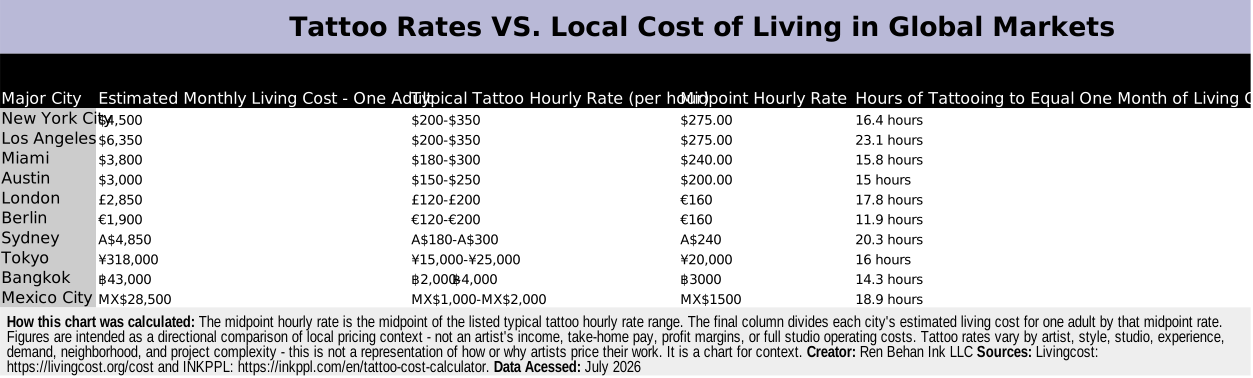
In seven of the ten markets listed, it takes roughly 14 to 20 hours of tattooing at the listed midpoint rate to equal one month of estimated living costs. This is not a profit chart - it's a local context chart. It displays how tattoo rates sit within each city's local economy; the artist will have business expenses to cover and personal bills to pay from their income.
From the perspective of a USA client, a tattoo may look much cheaper after a currency conversion. But within the local economy of where that tattoo is priced, that quote can occupy a much more comparable position than the raw dollar amount may suggest.
The numbers are far from identical - and they don't need to be! Los Angeles, Berlin, Sydney, Bangkok, and Mexico City are not the same markets at all. No honest comparison should even begin to pretend they are. These cities have different cultures, regulations, clients bases, and social attitudes towards tattooing. Those differences shape demand too - Japan, for example, still has more direct tattoo stigma than the United States in some settings.
But there is a pattern, and it matters.
A tattoo in Bangkok may cost less after a USD conversion, just as a tattoo in New York may cost more in the reverse. But the difference is not as simple as one artist being "cheap" and another being "expensive". Rates are shaped by the city an artist works in, the economic reality their business must survive in, and the culture of their country. Pair those factors with other things that shape artist pricing (demand, experience, style, complexity, etc...) and the rates will vary greatly because every artist will be different.
That's basic economics - not ego or greed.
Smaller Towns are a Different Market, Too
The same logic goes for towns within the United States.
A talented artist in a more rural town may charge substantially less than an equally capable artist in New York, Los Angeles, or Miami. That does not automatically mean they are less skilled. Their living costs and business expenses may be significantly lower. Local clients may have less spending power. Studio operating costs may be different, and the local market may not support major-city rates. Unless that artist is backed by pure fame and demand, they need the locals in order to thrive and will charge accordingly.
Does Flying Overseas Actually Save You Money?
The mean reality of travel costs...
Whether traveling out from the USA to a foreign artist is worthwhile is purely up to the client and their ink desires. Saving money may be what starts the idea initially, but once you run the math, it often is not the biggest advantage anymore. For a small or medium-sized tattoo, airfare, lodging, local transportation, food, travel insurance (if purchased), and unpaid time away from work can erase much or all of the apparent savings.
It's possible that larger projects can be a different calculation, especially if a client already plans to visit that country and/or intends to complete multiple sessions during one trip. But good luck to that pain tolerance and kudos if you can do it! Back-to-back marathon sessions to complete a full sleeve or backpiece will be intense, and you need to account for recovery and healing time. I highly doubt you would be up for going back to work after getting your whole leg blasted - standing alone will be painful for a handful of days.
Let's play around with a simple scenario as an example: say a tattoo abroad is quoted at $800 less than a comparable artist near home. Once you add a round-trip flight, at least one or two hotel nights, airport transfers, meals, and the unpaid time away from work, that $800 savings dissolves quickly.
Clients don't buy tattoos the same way they buy daily needs like groceries or gas. They don't always chase the lower price. A well-researched client chooses an artist whose style, experience, and body of work represents what they envision for their own ink. They follow what they trust will be worth the permanent change to their skin! Price can matter, sure, but reputation, specialization, and confidence will ultimately matter much more in the long run. Once they pick their dream artist - the geography becomes a secondary factor.
Honestly, the reason people cross borders comes down to one simple fact: they want that particular artist.
People Travel for Artists, Not Bargains
I'm not going to argue that international tattoo travel isn't worth it or doesn't make sense - that'd be ignorant. It can absolutely make sense for a number of valid reasons, but what it really comes down to is that travel is ultimately considered when it's for a highly desired artist - not just for some bargain hunt.
The hecklers screaming greed at U.S artists seem to forget that people travel here for tattoos all the time - and I assure you that it's not because they heard our paper towels are God's butt wipes. Nope - they book flights because the artist they really want is here. The United States is home to a large number of internationally recognized tattoo artists specializing in any style you can conjure. Social media accelerated these artists' exposure to other countries. International tattoo conventions exposed tourists to foreign artists. Years of building powerful portfolios enhanced client confidence. Now, people travel for tattoos all over the globe - not just for local zipcodes.
Why would foreigners fly into the United States when the exchange rate is working against them? Because they want ink from that badass artist they've been watching online. That's it.
Some collectors also consider professional standards. But excellent tattoo studios exist all over the world...but so do the bad ones. The USA doesn't have a monopoly on quality or safety - health and safety should be evaluated studio by studio, not country by country. Sure, licensing, inspection, and bloodborne-pathogen requirements can give clients confidence in the United States, while excellent, highly regulated studios exist abroad as well. Wherever you decide to book, look for proper licensing where applicable, clean procedures, single-use supplies, healed work, and a portfolio that genuinely inspires you!
People do not travel here because it is cheap - they travel because they trust the work of the artist they selected. That means something.
What You're Really Paying For...
Let's break it down a bit - you're paying for years of practice:
Thousands of hours of drawing
Thousands more hours tattooing
Refinement from learning from mistakes
A portfolio and reputation that took time to build up
Established sanitation procedures and high-end equipment
A single tattoo session itself takes 4-8 hours, but the artist's reputation and skill were built through years of hard work and ambition. All of that impacts the outcome of a client's new tattoo and their experience for years to come.
Additionally, tattoos are still one of the least expensive forms of custom art. Commissioning a custom painting, furniture, jewelry, or sculpture costs thousands. Now imagine a tattoo - you wear that every day and take with you everywhere. For decades. For possibly your entire life if you take care of it. Calculate that investment over the course of 40+ years and the cost seems much smaller.
If you spend $2000 on a large tattoo and live for another 40 years, that single work of art costs you roughly 13 cents per day! Compared to a daily coffee from Starbubs or a pair of designer shoes that last you maybe 2-3 years, a high-end tattoo is mathematically one of the most "efficient" luxury purchases a person can make on art.
Perspective changes everything. As my mathematician sister would likely put it - math quantifies abstract thought and makes it visible to the naked eye.
I know, it's cheesy, but nonetheless deep.
"I Can't Afford That Artist."
You know what? That's totally okay. A tattoo shouldn't put you into debt or strain your monthly expenses in such a way that you have to skip groceries or other necessities. But one of the biggest complaints with the most sought-after artists is also one of the best things about them: They're booked out. Six months, eight months, some even a full year or more. That waiting period isn't a downside - it's an opportunity to save for that dream tattoo!
Instead of settling for an artist because they can get you in next week and for cheap, take advantage of your favorite artist's booking periods. Save for the one whose work you'll still love twenty some years from now!
Here's what that can look like for the average earner:
Save $25 per week for a year and you'll have approx. $1300.
Save $50 per week for a year and you'll have approx. $2600
Open a separate account for your "tattoo fund" and transfer over a bit each payday so you're not tempted to use it. With most banks, you can even set up an automatic transfer so saving up is entirely mindless! Use the unexpected income - tax returns, overtime, bonuses, birthday money, tips - to build up your budget even faster!
Evaluate Your Spending Habits Honestly
This goes for all saving goals - but break down your monthly spending habits. Saving for a tattoo does not have to mean pretending you never deserve coffee, takeout, or a haircut. It's only about deciding what matters most to you right now and making those small adjustments and temporary tradeoffs that will move you closer to the goal: an awesome tattoo!
A single medium latte at a coffee chain costs roughly $5 - if you're stopping before work every weekday for the java spike, it adds up to $100 fast! Imagine if you made coffee at home? Depending on the coffee grounds or pods you buy, you can put away $80 or so each month making that change.
The average basic nail appointment with tip costs $80-100 - if you're going each month, that's another sacrifice that can be made to save for that desired ink fix. Same goes for professional hair appointments. If you love those mani-pedis, just don't go every month - you'll save even if you skip a month.
As for food - if you're all about convenience meals, the cost of restaurant dining, take-out, and fast-food can be quite shocking. Say someone working full time buys lunch everyday during their break - even if we estimate low, and assume the meal is between $10-20, that's $200-$400 per month. If you meal prep and get in the habit of making food at home, the savings are insane.
I'm an avid meal prepper, and this is what changed my perspective:
Pick two of three things:
Convenient
Cheap
Quality
If you choose Convenience and Cheap, you are losing out on Quality (Fast food and takeout)
If you choose Quality and Cheap, you are losing out on Convenience (Meal Prep)
Lastly, if you choose Convenience and Quality - well, it isn't gonna be Cheap (Restaurants or food subscriptions)
The goal is not to deprive yourself. It's to avoid making permanent decisions based on temporary impatience. Patience always pays off far more.
The Wait Can Be Part of Making the Right Decision
The fast pace of modern digital life and convenience has conditioned us to expect and seek out what we can obtain immediately. Unfortunately, tattooing doesn't always work out that way. An artist who is consistently booked isn't automatically the best, but they are busy for a reason: high demand. People are coming back to that artist, their tattoos heal beautifully, friends noticed and word spread. That artist built up the reputation - remember what we discussed before? That takes time.
If someone is creating artwork that will be worn for the rest of their lives, I think waiting a few months or more is much more reasonable in the grand scheme of things. Not only is the goal rewarding when it is finally achieved, but people change. Maybe you want to revise your idea with your artist, maybe you think a different placement would be better. In the case of anime tattoos - maybe a new anime comes out while you are waiting and you decide you want a tattoo of that new beloved character! Time is a tool!
Price Is Personal. The Tattoo Is Permanent.
Tattoo prices in the USA didn't rise because we artists are super greedy bastards. They rose because nearly everything required to operate our professional businesses became more expensive. At the same time, the industry became more competitive than ever before. I'm not here to defend high pricing or judge low-pricing, I'm just explaining the factors that go into why an artist may charge their rates.
The irony is that while clients have never had more quality options before, the artists who consistently produce exceptional work are often booked further out than ever before. That is not an accident. A strong portfolio, healed results, and trust still create demand. But sometimes, a client just wants a quick in-and-out walk-in tattoo for an easy price - and that's fine too.
Maybe that's the big takeaway that I wish negative social media commenters complaining about tattoo pricing would understand - the market is diverse, perspectives are just as diverse. There are expensive, moderately priced, and cheap artists - but which is more worth it to you as an individual? In my experience, the tattoos clients cherish the most twenty years down the line, are from the artists they trusted enough to support, save, and wait for.
Read up on more:
Market Calculation
Livingcost - Cost of Living By Country
U.S Bureau of Labor Statistics - Consumer Expenditure Survey and Occupational Data
SkyQuest Technology - Global Tattoo Market Report
Dojo Business - Revenue Breakdown
Health and Safety
Public Health Post - Tattoos, Regulatory Loopholes, and Who's Responsible?
New York City Department of Health - Tattoo Artist Infection Control Course Manual



Copyright 2026. Ren Behan INK LLC. All Rights Reserved.