Artificial Inspiration: Artists VS Prompters
Scraping Human-made Art off the Canvas
Industry Insights
Author: Ren Behan
The Ai Burglar - The Ultimate Art Heist
It's here, and it's not going anywhere. Ai has infiltrated multiple markets - both everyday people and companies are eating it up too. While many of us hoped Ai would take over menial daily tasks, allowing us more time to play and be creative, it instead seems to be taking all the fun and leaving us to do the dishes. This is evidenced in job trends and statistics via the U.S Bureau of Labor Statistics . According to Chiu, a journalist who analyzed 180M jobs to explore how Ai may be impacting the market, the top declines for overall employment has been for positions in the creative sector - more specifically, we're seeing the steepest drop in graphic designers, photographers, computer graphics and VFX roles, and in writers (ghost writers, screen writers, editors, etc...). And yet leading roles, like art directors and producers are actually growing! Don't even get me started on the growth we are seeing for Influencers shilling out products. The reality is, that over a short amount of time, we've seen Ai have what appears to be a severe take over in creative industries.
It's no theory why this is happening. Ai models are capable of dishing out projects in seconds when artists need hours, days, and maybe even weeks to produce quality work. The convenience pays for itself, and corporate fat cats love increasing profit margins. Why bother hiring an illustrator, concept artist, or graphic designer when Claude or Chat GPT can spit a bitmap out off a two sentence prompt? That's the logic of a businessman - but they are willfully ignoring the damage to creative industries and dismissing the consequences it will have down the line because MONEY! And it is all possible because of the hard work of artists - and they'll never receive credit for it.
For us to truly breakdown and understand why artists feel their work is being stolen, we must first understand the technical pipeline behind image generation models. It’s not as simple as copy-pasting or replicating. Ironically – I used google search (which is powered by an Ai now - note the Ai overview on your searches) to explore and research how AI does this. There are many resources that describe the process (https://guides.csbsju.edu/AI-Images , https://www.canva.com/help/ai-image-generation-apps/ , https://guides.library.utoronto.ca/c.php?g=735513&p=5297039 ), but let me wrap it all up and put it as simply as I can.
How Generative AI uses and collects data
Scraping the wide web for resources
Generative Ai models require millions of image-text pairs to learn how to make visual representations of a user’s prompt. Of course, the sheer number required is not something than can be done manually, and so developers instead opt for automation – directing bots (web crawlers) to scavenge the open web for pubic-ally accessible images. The bots download images from online portfolios, galleries, social media posts, forums, and stock libraries – downloading images and their meta data, alt text, and captions. This is why so many pro-Ai companies argue fair use - because the Ai is scraping images that are accessible online. Remember: an AI relies on the text descriptors of images to understand the correlations and find patterns - it can't actually see in the way a human eye can.
In most cases, this “scraping” is done entirely without the knowledge or consent of the artist – even going as far as to totally ignore the Terms and Conditions of their website that may forbade such use of their sites. The artist is never credited for having had the Ai use their work, nor are they compensated. This is the affront.
The Math Behind the Theft
A very common misconception permeating social media comment sections is that AI copy-pastes the fragments of many images into the generated image – that it just collages millions of images into one that best meets the prompt’s demands. It’s not so simple as that – instead, it is mathematical fuckery. The AI model processes images it collects into what is pretty much an artificial neural network, looking for visual patterns.
Random Gaussian noise is added to an image bit by bit until it becomes pure static – and then the AI tries to reverse this process by building it back to it’s original form. This breakdown and building trains the AI to recognize how to reconstruct an image and better predict how best to remove or add noise. It does this billions of times until it has a mathematical coordinate system. This is called Latent Space.
Image Generation
When a user types in a prompt like, “generate an anime girl in a watercolor beach scene”, the AI will navigate to the Latent Space, following the coordinates best associated with those keywords, and generate a cluster fuck of pixels that conforms to the user’s request. The final output is a bitmap, which if you don’t know what that it, it’s a grid of binary data - but it’s structure and framework is distilled directly from the crafted work of humans.
Why is this harmful to creative industries?
Non-Consensual Exploitation Without Compensation and/or Credit is a Moral Affront...
The heart of the problem is the profiteering off an artist's hard work without consent, without crediting the artist, and without compensating them. It's exploitation. Companies make money off their Ai Models and none of those profits benefits the artists whose works were downloaded. These downloaded works are stolen and are actively used with every prompt to create images for subscribed users. Scraping publicly accessible portfolios and images treats human creativity as a readily-available resource to be mined freely.
Economic Undercutting
Commissioned or commercial art (think concept artists, graphic designers, illustrators, book cover designers, storyboarding, etc...) relies on clients paying for and supporting skilled artistic labor and experience to create new works. Ai has fundamentally dissolved production costs and time-frames to near to nothing. While this seems like a major cost-saving benefit for clients since an Ai is capable of generating hundreds of high-fidelity pieces at a super low cost, art and design commissions have seen a sharp decline. The reality is that creators are seeing their own works and life-long built portfolios being consumed to feed a tool that is essentially stealing their ability to earn a living. All of this, within a few years time. No one was prepared for it.
Devaluation of Craft, and the Loss of Respect for Skill
Skilled craft and design takes time, constant practice, and total dedication. An artist builds their skill with every piece they create. Every year passed is a whole lot of skill gained, which is why the value of an artist's work is ever-growing as they perfect their technical ability and share their work. Over the past decade, I've watched a new sort of mindset grow bigger in our society - that an artists work and dedication belongs to the viewer. I've seen the respect and love for art and creation dissolve into a sort of entitlement - it's been devalued, and Ai has not helped this mindset.
Ai feeds society's powerful need for instant gratification and abundance. It's devaluing human-guided expression and thoughtful creation. It creates what appears to be highly detailed and designed artwork in mere seconds when a commissioned artist needs hours. Commercial businesses are especially accepting of this new tool as they prioritize profit-margins and fast production over the process of commissioning an artist and waiting for them to meet the deadline over the course of weeks to months. Convenience wins over patience and budgeting. I won't deny that it is highly efficient, and I don't blame people for being so drawn to the convenience of Ai image-generation. But take care not to grow fat on it - know where who to look at when you wonder why human-craftmanship has eroded - right in the damn mirror.
Why is the Erosion of Human Creativity a Problem?
Ai needs human craftmanship - what happens when that resource runs out?
Did you ever notice how alike Ai generated art looks? Or how, with critical analysis, we can look at an image and figure out whether it was an original creation or Ai slop? While it has gotten harder to tell for some things, for the most part, Ai is easy to spot with a careful eye for detail. As we discussed, Ai relies on the collection and the statistical analysis of image/text pairings to figure out how best to generate a prompt. That means it needs existing original works in order to function.
Ai literally automates the learning process - taking minutes to collect information that takes a human weeks to months to years to learn - but this does not equate to creating new knowledge. The images for an Ai's training must come from somewhere. Much like how an artist needs to reference images to properly convey their vision, an Ai needs resources to draw information from in bulk. An Ai learning off the images of other Ai can result in the reproduction and affirmation of mistakes and flaws that the previous Ai failed to generate properly. What happens if the artistic industry depletes and Ai is the dominate image-generator? Generating a plethora of images is not the same as supplying new experiences, skillful techniques, or even the deeper meanings behind an image and its creation.
Ai-generated content is flooding the internet
Evidently, Ai-generated images and texts have flooded the internet since it's big debut in 2022. According to the Pew Research Center, Ai was detected in more than 1/3rd of 10,000 webpages in their random sampling. That is significant. While we do have to remember that Ai detection tools are not perfect - especially in written texts. There are patterns in how people write. A person like myself (someone who has a Bachelor's in English Writing and Rhetoric) writes very differently than the common person. Ai mimics academic writing and even over represents some of the common patterns used in it, and so you may see more em dashes, lists of threes, oxford commas, negative parallelism, uncommon vocabulary, and just writing that feels way too robotic. The human quirks that differentiate a writer from another are not there - it's uniform.
Evidently - since 2022, more than 15 billion images have been created using Ai models. I say evidently, because all the sites and articles quoting this metric are using circular journaling (when a claim is backed by many independent sources, but the sources all cite each other), and the graphs depicted cite the actual Ai models as the sources for the information. This is where I urge everyone to be careful in trusting Ai generated answers to your questions - dig deeper! Ai is not perfect and it is not always accurate. However, knowing this, we can still stipulate that even if the percentages may be slightly inflated or even short of the truth, it is non-the-less concerning. We have people claiming that of all online images, approx. 50%-75% are now Ai generated. Hell, if you told me more than 15-25% of images online were Ai-generated since 2022, I'd be flabbergasted! So to think there's a possibility that it could be more than that is insane. One of the more commonly cited sources for these sorts of claims is from everypixel - but again, the sources are all citing each other so it's not entirely reliable. Do your research, fam!
And Now We Come to Our World - The Anime Tattoo Industry
If you use Ai to generate a design - you are a prompter, not an artist...
When a client hires a tattoo artist to permanently mark their skin with an image, they are not paying for that same artist to prompt Ai to throw together a design...this is supposed to be part of the service. A tattoo artist will compose a design custom to the client's vision using their long-time developed skills to create something new. A prompter is not an artist. An artist is defined as someone who creates works using creativity and technical skill - they can be illustrators, painters, photographers, graphic designers, etc... - A prompter is utilizing a machine mind to make a derivative from the works of other artists...that is not a creation from imagination and technical skill.
If you trace/copy another person's fanart and/or Ai generated art - you're a thief, not an artist...
It's already taboo to directly copy and steal the works of an artist without permission. In the art community - even with tattooing - it was expected that you get the permission of the original artist and credit them with the design for your tattoo. Sometimes its the client that gets permission, and sometimes its the tattoo artist. Only a scummy poser directly copies another artist's work without consent and/or crediting them with the design's original creation. As we have broken down in detail and discussed, Ai relies on a database of non-consensually acquired works downloaded from publicly accessibly online portfolios. Even if a work is Ai generated, tracing and tattooing it for profit is still theft.
Some may argue that tattoo artists photoshopping images together to make their designs is no different - but I disagree. A color realism artist needs real-life references and photos. Expecting them to creating hyper-realistic works that take 20-36 hours to compose for a number of clients each week would be unrealistic. So mashing up images to create something new is a new-interpretation and once they translate that to skin, they often will take even more creative liberties to make it their own. But I see the argument - some believe an Ai is referencing images and reinterpreting it as something new - similar to how an artist would. But really, when it comes down to the coding and the actual process of how an Ai model scrapes and trains off existing images like we discussed prior, you'll find that the two processes are very different.
When an artist reinterprets an image, they are making creative choices based on their personal experiences and technical expertise. An Ai generator has no intent or emotion outside of its programming, and so it simply breaks down existing works into mathematical equations to calculate the most likely arrangement of pixels to match a human's prompt. I wouldn't call that creative or imaginative. A prompter having a cool idea and giving it to Ai, but then claiming, "look at what I made!" is just as bad as a director having their concept artist draw up a character idea, take it, and claim, "look at what I created!". The idea may have been unique and totally yours, but the execution was outside of you and credit is due.
If you use Ai without disclosing it to your clients - you're a fraud, not an artist.
Most people commissioning artists in any sort of creative field would be pissed to discover they are paying that artist to prompt a machine to generate a design - they can do that themselves, so why are they hiring you!? In no way should any client be okay with this. When you commission a tattoo artist, the design process is included in the cost of the service - what you pay at the end of the session is for more than just the tattoo session. You are also paying for the time the tattoo artist takes to design your tattoo. You may not be paying for the design itself, but you are absolutely paying for the whole of the service we offer. That is the soul of being an artist - creation. A client hires an artist to make their vision a reality - they are not paying for that poser to prompt the Ai to do all the design work for them. The only time this is acceptable, is if the tattooer is disclosing that they are using Ai in their process so that the client can decide if they are okay with this before being locked in.
If you copy other tattoo artists using photos of their client's tattoos and/or running them through Ai - you're an imitator, not an artist...
Like many these days, I've had my own work stolen a number of times from other artists. They download the tattoo photo from social media, throw it into Ai with a few prompts, and the Ai regenerates my client's tattoo into a "new" image. But its always glaringly obvious - there will be things the Ai misinterprets and leaves as a ghost of the original photo, odd blank areas where the prompter asked the Ai to remove some detail that the Ai failed to make consistent with the rest of the piece, and even anatomical mistakes that the Ai failed to translate properly and the imitator failed to catch and fix.
I always draw entirely from scratch, I never trace or directly copy. But man do people like to do that to my own work and to the works of others. When I've called them out - they either try to gaslight me by saying its because we likely referenced the same sources, or that they were so inspired by mine that they wanted to do their own version (or rather, the Ai's version of my piece). What's worse, is that my client's tattoo photo was stolen from my portfolio to be copied and replicated onto someone else. That's fucking gross. These people are giving literal photos of my client's body to an Ai to steal the custom work my clients hired me to do. It's a damn shame.
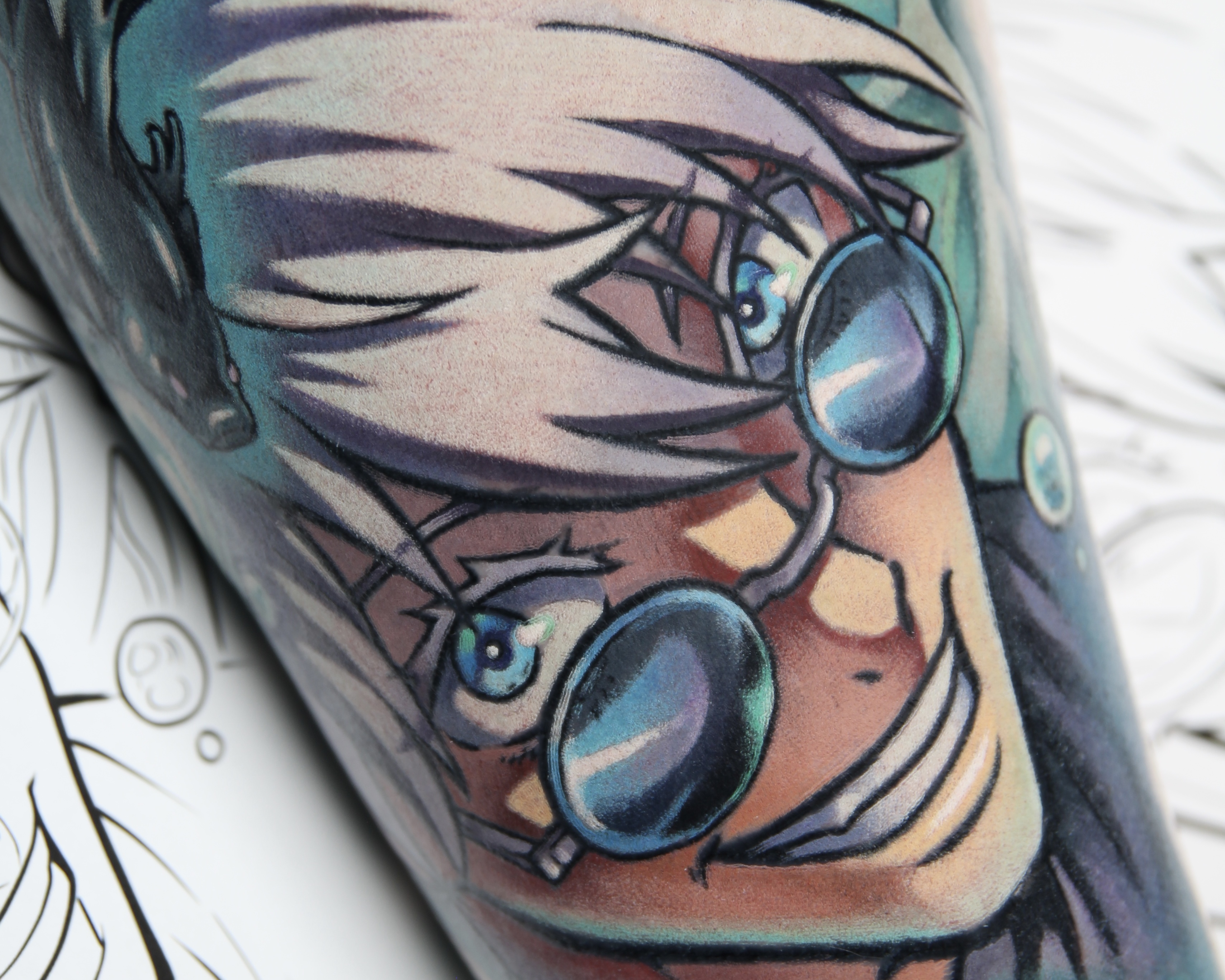
This is where I urge clients to take their time researching tattoo artists - don't settle! Pay attention because Ai-generated tattoos have evidence, you just have to know what to look for. Take these two images as a great example of what to look for! The first is my competed tattoo on my client, and the other is the Ai slop a tattooer generated from my work.
Though it is glaringly obvious from the get-go that the second image is Ai-generated, to some, it may be more difficult to catch. Ai has a strange look to it - not pixelated, just softened with noise. This is part of that diffusion process we discussed prior. An Ai can also ghost details from original works into the prompted picture. Note how the Ai merged the fish from my original design into Gojo's hair in the stolen one.
There will also be reminents of the original design that make no sense in the new piece. My design focused on the betta fish as a symbol of Gojo and Geto's relationship, and I used water details to frame the piece to emphasize this thought. In the prompted image, the water elements remain, but they make no sense with the rest of the piece - this is because the tattooer that prompted it lacks a sense of design. They rely too heavily on what the Ai spits out, and the Ai isn't creative nor does it design with intent. Just some food for thought the next time you research an artist - their work shouldn't just look pretty and be well executed...it needs to make sense.
A photo of my client's JJK tattoo that I custom designed.
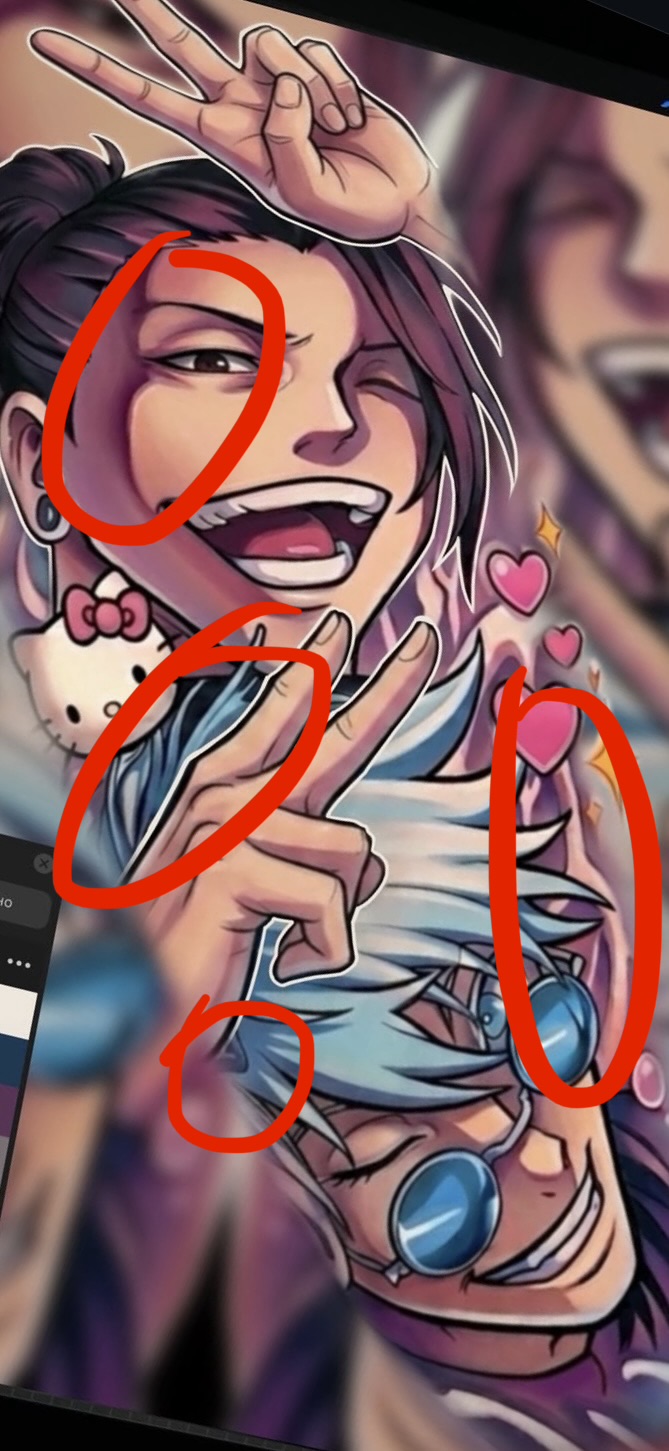
The "design" an tattooer ripped using my photo of the JJK tattoo I completed - circled portions are the evidence of Ai (Why is the fish fin and nose a part of Gojo's hair???) It barely changed a thing, and the tattooer played it off online like a design he whipped up from scratch.
We've talked on the bad, but where is the good?
Can Ai be a tool that supports rather than steals?
I posed some questions to my newsletter subscribers about Ai to probe their thoughts on the matter. Most if not all believed Ai is harmful to creative industries - specifically artists. However, some made excellent points as to how Ai may be helpful to others. Those who may have never hired an artist anyway are able to ask Ai to generate their idea (or meme) visually for personal use or for fun, or they may use it to help with coding or solving a complex technical issue on their computer that is beyond what they alone can understand. For the common person, Ai may seem like a remarkable tool! And I do agree! I see the potential in how it can help with daily menial tasks, trouble shooting, and even in research and development - so long as human involvement and intervention is still priority. Or as we've discussed, a prompter isn't trying to pass their Ai-generated content as totally their own creation. In the creative industry, I can only see harm as of now. Ai image-generation models are built entirely on the backs of artists who only wanted to share their work.
The Human Premium
Is there still value in human-made art?
Those who are pro-Ai are claiming that artists who fight back will get left behind - that this is the way now. But is it? The over abundance of Ai images and the lack of originality in them seems to be having the opposite effect. Traditional artists are becoming an exclusive luxury. We're calling this the "Human Premium". While Ai can mimic and seemingly replicate the skill and detail of an artist's work, it lacks severely in creativity. In a small study, researchers selected 28 images; half from real artists, and half Ai-generated, and when participants viewed a human-made work beside an Ai-generated one (without knowing which of the two is which) 62% of the time, they showed preference for the human-made works on creativity. Could this be a chance for artist's to flaunt their human-made works as a flex? Absolutely it is.
I'm personally seeing an increase in demand for human-made art - consumers seeking artwork are asking the important question, "Did Ai make this?" or "Was Ai a part of the creation process". Even art mail clubs are growing in popularity because people want easily accessible artwork from a real person! This is actually what inspired my own art mail club, Kaiju Crushes!
In the tattoo world, clients are starting to notice the influx of fake ai tattoo videos, ai-generated designs, and even calling out artists who either stole fanart or used Ai to make their designs! Tattoo artists are also taking charge in calling out prompters - in recent events, tattoos of ai-generated works were winning in tattoo contests, and both clients and artists are loudly against it.
All in all - it appears human-made works is still cherished and preferred by the majority! That's a win.
The Wrap Up
Let's put the cherry on this mess...
I'm not here to demonize Ai or rip apart people who use it. In fact, I do believe Ai can be used for good things, and that it can be a great tool! However, as part of the artistic population, I feel ripped off. I want to do my best to not make anyone feel guilty for using Ai to generate fun images for their own personal use, or even for modifying their selfies into something comical to share with friends and family. I only want to spread awareness. That's it. You've heard the saying - we put out blood, sweat, and tears into our works, and it's not really an exaggeration. The me today is a result of the work of me yesterday, a month ago, five years ago - a decade! The violating feeling of a machine downloading my illustrations and replicating it in seconds for a prompter to claim as their own hurts.
Many artists share the same sentiment, and we only want to be heard, and our works protected. But we also want to protect you. I've had a number of people reach out to me privately sharing their disappointment upon discovering that their tattoo artist use Ai to generate their design, and they only found out during the tattoo session, or afterwards once it was all said and done. A particular person felt totally violated and trapped when the artist had mentioned off hand that they used Ai for the design - they were already in the middle of the tattoo! This isn't right, and you deserve better from this industry. We are only able to tattoo because you trusted us to do so, and we should show you the same respect.
Please protect yourself, do research, and ask questions.
With love,
Ren


Copyright 2026. Ren Behan INK LLC. All Rights Reserved.